

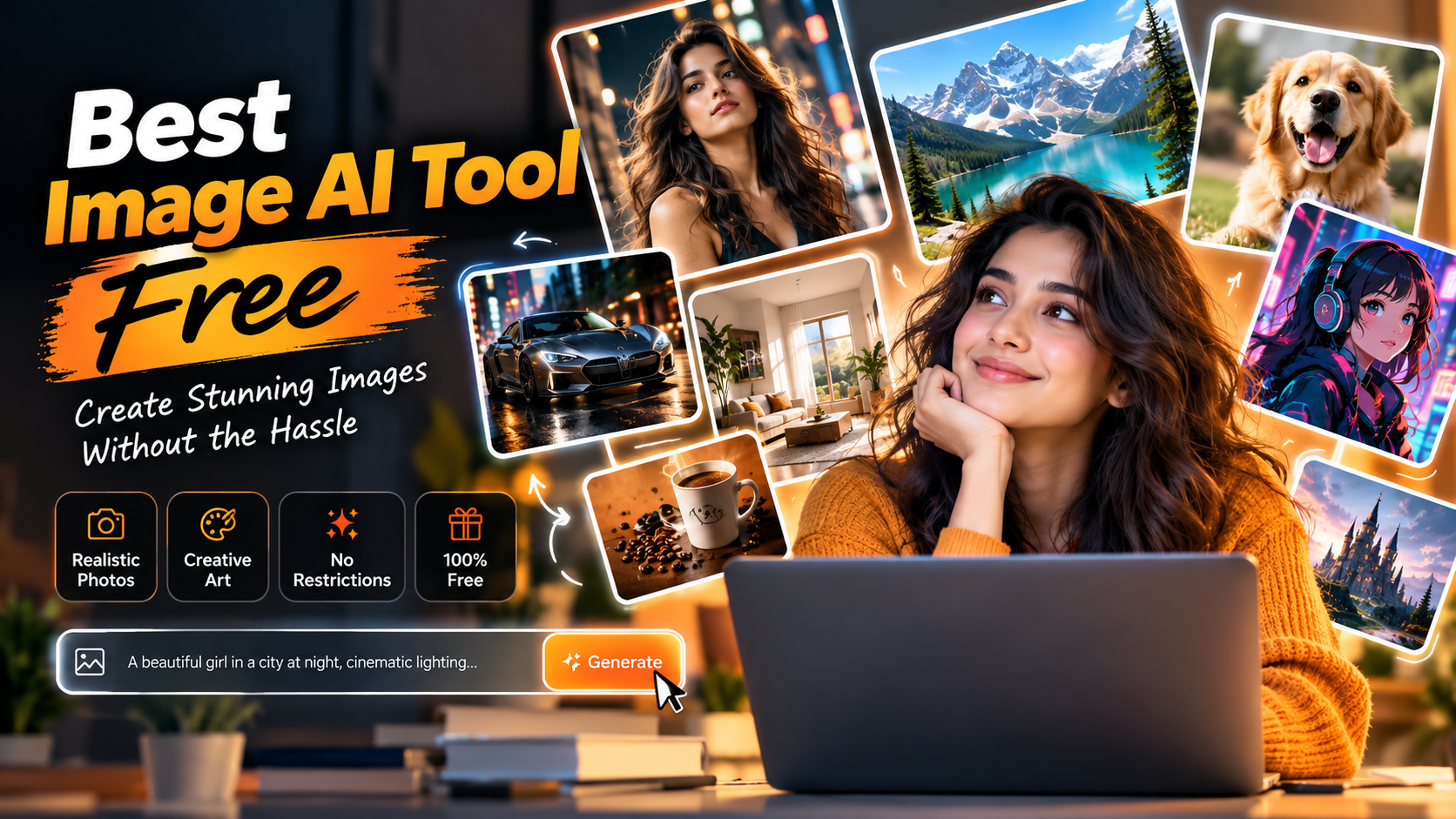
1. The AI Image Revolution Is Here
Creating great images used to mean opening Photoshop, learning complicated editing tools, finding stock photos, or hiring a designer. Now, things have changed dramatically. With AI image generators, you can simply describe what you want and let AI turn your idea into an image.
That is why people are searching for the Best image ai tool free options. Whether you are a creator, marketer, blogger, student, designer, or business owner, a good AI image tool can save hours of work. Instead of starting with a blank canvas, you can start with an idea and let AI handle the visual creation.
2. What Makes an AI Image Tool Actually Good?
Not every AI image generator works the same way. Some tools focus on photorealistic images, while others are better at illustrations, anime artwork, logos, posters, or creative concepts. Therefore, choosing a tool depends heavily on what you actually want to create.
A useful free AI image tool should offer simple prompting, good image quality, quick generation, and enough creative control to experiment. Ideally, it should also have a generous free option so you can test different ideas without immediately reaching for your credit card.
3. Why Free AI Image Generators Are So Popular
One major reason AI image tools have become so popular is accessibility. You do not need advanced design skills to create something impressive. You can write a simple description such as "a stylish woman walking through a futuristic Tokyo street at night" and receive a completely new visual concept.
Moreover, free tools make experimentation much easier. You can test different prompts, styles, lighting setups, camera angles, colors, and compositions. As a result, beginners can learn visual prompting simply by trying different ideas and seeing how the AI responds.
4. Creating Realistic Photos With AI
One of the most exciting uses of AI image generation is creating realistic photos from text. Modern AI models can generate portraits, landscapes, interiors, fashion photography, food photography, product scenes, and cinematic compositions with impressive detail.
For example, you could describe a professional product photograph with soft studio lighting, a clean background, realistic shadows, and a premium commercial look. The AI can use those instructions to build a scene without requiring you to rent a studio or arrange a physical photoshoot.
5. From Simple Prompts to Incredible Results
The secret to getting better results is not always choosing the most complicated prompt. Instead, focus on clearly describing the subject, environment, lighting, composition, mood, and visual style. The more useful information you provide, the easier it becomes for the AI to understand your creative direction.
For instance, rather than writing "a man in a city," you could describe a young man wearing a black jacket standing on a rainy street, neon signs reflected on wet pavement, cinematic lighting, shallow depth of field, and a realistic editorial photography style. This gives the model much more visual information to work with.
6. Can You Really Get AI Images With No Restrictions?
The phrase no restrictions can be misleading because every AI platform has its own usage limits, content policies, generation quotas, and technical restrictions. A tool may be free while still limiting the number of images you can create each day.
Therefore, when comparing free AI image generators, look beyond marketing claims. Check whether the service requires credits, adds watermarks, limits image resolution, restricts commercial use, or limits certain types of prompts. A genuinely useful free tool should clearly explain what its free plan includes.
7. AI Images for Social Media Creators
Social media creators can get tremendous value from AI image generation. Instead of searching through stock libraries for the perfect visual, creators can generate images specifically for Instagram posts, Facebook graphics, YouTube thumbnails, Pinterest content, blogs, and other platforms.
Even better, you can create a consistent visual style for your content. For example, a technology page could use futuristic backgrounds, glowing interfaces, modern typography areas, and dramatic lighting across multiple posts. This makes content creation faster while also helping maintain a recognizable visual identity.
8. AI Images for Bloggers and Websites
Bloggers can also use AI-generated images to make articles more engaging. A strong featured image can immediately communicate what an article is about, while supporting visuals can make long sections easier to understand.
For example, an article about artificial intelligence could include a futuristic workspace, an AI robot collaborating with a designer, or an abstract visualization of machine learning. Because the image is generated specifically for the article, it can match the topic much more closely than a generic stock photograph.
9. Product Photography Without a Studio
AI image generation is also changing product photography. Small businesses can create marketing concepts without organizing an expensive photoshoot for every campaign. You can place a product into different environments and experiment with backgrounds, lighting, colors, and compositions.
Imagine having one product photo and generating several creative scenes around it: a luxury studio setup, a minimalist desk, a dramatic outdoor scene, or a colorful lifestyle environment. This approach can provide many visual directions for advertisements and social posts while reducing the need for repeated physical setups.
10. How to Write Better AI Image Prompts
A good prompt usually answers several basic questions: What should appear in the image? Where is it located? What does it look like? What lighting is being used? What camera or composition should be used? What mood should the image communicate?
You can also experiment with photography terminology such as close-up portrait, wide-angle composition, shallow depth of field, studio lighting, cinematic lighting, editorial photography, soft natural light, and high-detail textures. However, avoid stuffing your prompt with random keywords. Clear instructions usually work better than a long list of unrelated terms.
11. Free Doesn't Always Mean Low Quality
There is a common assumption that free AI tools must produce poor results. That is no longer necessarily true. Many free services can produce surprisingly impressive visuals, especially when you use strong prompts and understand the tool's strengths.
However, free plans often come with trade-offs. You may encounter generation limits, slower queues, lower resolutions, fewer editing options, or restrictions around commercial usage. So, before using an image for a business campaign, always check the platform's current licensing terms.
12. Finding the Right Tool for Your Creative Style
There is no single AI image generator that is perfect for everyone. A photographer may prioritize photorealism, while an illustrator may care more about artistic styles. Meanwhile, a marketer might need fast generations, commercial-friendly licensing, and simple editing features.
Consequently, the Best image ai tool free for you depends on your workflow. Try several tools if possible. Generate the same prompt on different platforms and compare the results. Pay attention to image quality, prompt accuracy, speed, editing capabilities, available styles, and free usage limits.
13. A Simple Workflow for Better AI Images
Start with a basic concept. Next, describe your subject and environment. Then add lighting, composition, mood, and style. Generate an image and inspect what worked. After that, modify only a few parts of the prompt instead of changing everything at once.
This process helps you understand which words affect the output. Over time, you will develop your own collection of useful prompt structures. Eventually, creating a strong AI image becomes less about guessing and more about giving the model clear creative direction.
14. The Future of Free AI Image Creation
AI image generation is evolving quickly. Tools are becoming easier to use, image quality continues to improve, and editing features are becoming more integrated into everyday creative workflows. Instead of simply generating an image from text, newer systems can increasingly help users modify existing visuals, create variations, expand compositions, and refine specific elements.
As the technology develops, AI image creation will likely become a normal part of content production. Designers, creators, entrepreneurs, and everyday users can use these systems as creative assistants rather than treating them as replacements for human creativity.
15. Final Thoughts: Your Imagination Is the Starting Point
Finding the Best image ai tool free is ultimately about finding a tool that fits your needs. Do not choose a platform simply because it promises unlimited generations or no restrictions. Instead, look at image quality, usability, generation limits, licensing, editing features, and the type of images you want to create.
Most importantly, experiment. Try different prompts, styles, compositions, and ideas. Whether you want realistic photos, social media graphics, product visuals, blog illustrations, or completely imaginative artwork, AI gives you a remarkably accessible way to turn words into visuals.